October 3, 2026
A 6 Year-Old's Nature Notebook from 1925
.jpg)

The Armitt Library & Museum Centre houses the Charlotte Mason Archive, found and restored by the late Dr. John Thorley (read more of the history here). The collection includes Charlotte Mason’s published writings, letters, The Parents’ Review magazine which she founded, and many documents related to the Parents’ National Educational Union and Parents’ Union Schools which were the community of educators using the curriculum Charlotte Mason created. The collection also includes pamphlets, documents, and other articles related to the House of Education training college for teachers in Ambleside that Mason founded, including some artifacts by these teachers-in-training. As part of the House of Education, Mason also founded a school for children in Ambleside where these teachers could practice (affectionately nicknamed “The Beehive”).
Although most of the Charlotte Mason Archive features artifacts related to the training college or Mason’s various publications, there are a few examples of student work from this practicing school or other P.U.S. schools or from parents who sent in student work at the time or much later. Mason published some student work in various issues of The Parents’ Review and in her books, but there are additional documents in the Charlotte Mason collection which show original documents of student exams, or, as this article features, a young child’s nature notebook. These rare student documents provide a glimpse of the children who lived the original Charlotte Mason curriculum.
On a recent trip to the Armitt as part of their research as Scholars in Residence with the University of Cumbria, Kerri Forney, CMI’s Executive Director, and Shannon Whiteside, Alveary Program Director, uncovered a new artifact – a little girl’s nature notebook. The excerpts shared below are only available thanks to the continued work of the Armitt Museum and Gallery to preserve and provide access to these materials, and CMI is grateful for our ongoing partnership with the Armitt.
A 6 Year Old’s Nature Notebook
Margaret Elizabeth Deering (Betty) was born in Cardross, Scotland on February 4, 1919 (according to both the date on her notebook and Scotland’s statutory registers).
Since there are no records of a P.U.S school in Cardross, Betty’s parents must have signed up with the Parents’ National Education Union, received the pamphlet’s with the term’s programmes and exams from Ambleside, and educated her at home for at least the early years of her schooling. By the time Betty started school, Charlotte Mason had published just over 100 programmes (one for each term, with three terms per year), and Betty began her P.N.E.U education learning the selections assigned as part of Programme 101 (which covered the January to March term in 1925).
So when she was just 6 years and 8 days old on February 12th, 1925, Betty began her nature notebook. That first day she painted and labeled a horse chestnut twig and dictated her observations for her teacher to write in her notebook (likely her mother or a governess): “This is the first twig that I have painted in my life. We found some flowers out yesterday, they were coltsfoot, dog’s mercury and willow. There was a very high tide the day before yesterday. There is snow on the hills opposite.”
- Further entries and commentary follow below, but if you are interested in seeing a scan of the whole notebook, click here and we’ll send it to your email!
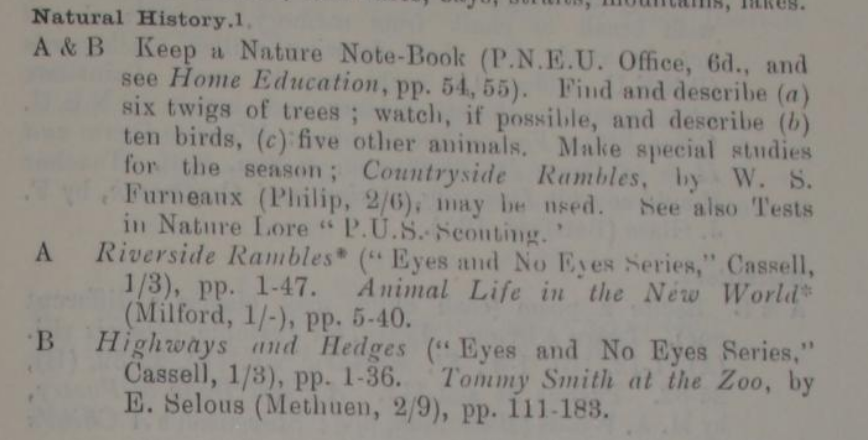
In Natural History for Programme 101, Form I students (ages 6-9) are assigned to “Keep a Nature Note-Book” and to “Find and describe (a) six twigs of trees; watch, if possible, and describe (b) ten birds, (c) five other animals.” While various gaps between dates in Betty’s notebook makes it unlikely that she entered something after every outdoor excursion, this emphasis in the programme does appear in Betty’s entries during her first term as the following transcriptions show.
Nature Notebook Transcript: February – June 1925, Betty Deering (Age 6)
Feb. 12.
- This is the first twig that I have painted in my life. We found some flowers out yesterday, they were coltsfoot, dog’s mercury and willow. There was a very high tide the day before yesterday. There is snow on the hills opposite.
- Horse Chestnut twig painted
.jpg)
.jpg)
Feb 18
- Beech twig painted
Feb. 25.
- There is heaps of gorse out. We are looking for the alternate-leaved golden saxifrage, but we can’t find it, but we have found the opposite. It will soon be bird-nesting time.
Feb 26.
- Sycamore twig painted
March 5.
- We saw some lambs last Friday when we were in the bus, they looked sweet. The tide looks high and it looks rough too. The buds on the trees are beginning to get fat and the horse chestnut buds are sticky. The crocuses and daffodils are coming out.
- Lime twig painted
March 6.
- We heard a lark singing this morning for the first time this year. We saw some hawthorn buds which had burst and we saw their green leaves showing. They were quite big. There were lovely rainbows this afternoon.
March 12.
- We saw some old nests, but the birds haven’t begun to build new ones. We found some primroses out for the first time this year. We found elm flowers nearly out.
- Willow Palm twig painted
March 19.
- The horse chestnut leaves are coming out.
March 26th
- Wild Cherry twig painted
.jpg)
April 2.
- The leaves of the horse chestnut are coming out. We had some snow yesterday and the day before. The daffodils are coming out.
- Oak twig painted
April 9.
- The cherry blossom is nearly coming out in the garden.
- Rowan twig painted
May 14.
- The trees leaves are right out. It is a lovely sunny day to-day. We have got 71 flowers on our list. We found some birds’ nests last week.
- Rowan leaf painted
May 15.
- Went a lovely walk on the craigs. We heard the corncrake there in a field, but we couldn’t get up to it, we wanted to see it. It was thick with bluebells, we saw the bees going in them to get honey. The rowan flowers will soon be out. We saw two birds nests with eggs in. I got a branch of black ivy leaves. The road is covered with cherry petals which looks like confetti.
May 19.
- I heard the cuckoo this morning for the first time this year. On last Saturday we saw some swallows for the first time. We found a white wild hyacinth to-day. We found a lot of new flowers, one was water avens, and bugle and lady’s mantle and water blinks, it grew right in the stream on a little island. We got woodruff too and wood sanicle nearly out. It is five flowers altogether.
May 21
- Ash painted
May 28th.
- We found milkwort all different colors, some were dark blue and some light blue and some white and pink. The corncrake is very common. We found raspberry flower out too.
- Horsetail Painted
June 4
- Cherry painted
Nature Notebook Transcript: January – June 1928, Betty Deering (Age 9)
Note
Betty's first nature notebook continues for three years through early summer of 1928. After the first year, the writing script changes and looks like that of a much younger writer, indicating that Betty herself began to write her own entries – though several different writing styles appear throughout the last two years, so it seems Betty was either experimenting with her writing styles or dictating to someone else at various times. Here are Betty’s entries from the spring term of 1928, 3 years after her first ones. At this time she would have been working through Programme 110 and possibly in Form 2.
Transcript
January 26.
- We have found out already the following flowers: Gorse, Daisy, Groundsel, and a bit of Ragwort from last year. Sweet Cicely is also beggining [sic] to come up. January has been a very wet month this year.
- painted Broom
February. 2nd
- I have noticed that Scurvy Grass leaves sometimes have conspicius [sic] beings, whereas sometimes they have not, just faint yellow-green ones. The snowdrops are almost out, so are some of our indoor bulbs. There is some snow on the mountains opposite.
- Scurvy Grass leaves (with and without veins) painted
.jpg)
.jpg)
Feb 9th.
- We have had awful weather, and have not been out to see things. The birds have begun to sing.
- painting of shells.
Feb 16
- The other day we saw a lot of bluetits flying in the hedges in front of us. Also we saw some gold finches.
- leaves of Honeysuckle painted
Feb 23
- Sycamore wing sprouting painted
March 1st
- We saw last Friday, for the first time, some lambs, they were sweet. I found an insect in a hogweed stalk on the ground. It looked like an ant. It had some eggs.
- twig of Guilder Rose painted
March 3
- In our garden today I heard a bird singing. It looked like a sparrow, but sang like a robin. It may have been a young robin without a red breast. It had pale pink legs.
March 8
- twig of Hawthorn painted
.jpg)
March 13
- Hazel Painted
March 20
- Red Sycamore painted
March 29
- We have found primroses out, both kinds. A few days ago we saw a woolly caterpillar. The hedges are coming out in parts, also a few daffodils. The birds look as if they are beginning to build their nests.
May 3
- Cuckoo Flower painted
May 10
- We went the day before yesterday to the moor. We heard a coockoo [sic], saw two partridges, and found some primroses.
- painting of Dog Violet and Marsh Violet, and Wood Violet
May 17
- Spring Vetch painted
May 29
- We saw yesterday a sweet little nest, lined inside with horse hair. It had five eggs in, grey, spotted with darker brown.
- Wood Sanicle painted and possibly Long Rooted Cat’s Ear (not dated)
May 31.
- We saw yesterday a thrush nest. The eggs looked a bit dirty, and twice when we passed it there wasn’t a bird on it. I found lilac flowers with 5 and 6 petals instead of 4. I have found lately two dead bird’s, young sparrows, with no feathers.
- Thrush’s egg painted
June 7
- We went a lovely walk in the fields and found two blackbirds eggs with a hole in, the young birds must have come out. We also found a whole thrush’s egg, quite cold. All of these eggs we found in nests.
June 14
- Potted Orchid painted
.jpg)
- Interested in seeing a scan of the full notebook? Click here and we’ll send it straight to your email and stay tuned for a sequel to Betty Deering's story!
Want to explore further?
For more on notebooks and nature study in a Charlotte Mason education, you may enjoy this short video on all the different notebooks in a relational education, 12 Tree Walks from our Alveary Nature study resources, a post about nature notebooking for a student with learning challenges, and a Mom's experience growing with her own nature notebook.
